October 5, 2026 · CutClub Team
Remote Team Building Without Another Zoom Meeting: 10 Async Activities That Actually Work
Looking for remote team building without another Zoom call? Try these 10 async team activities designed for distributed teams and different time zones.

Remote team building has a scheduling problem.
The usual solution is another calendar invite. A virtual happy hour. A team game. An icebreaker squeezed between actual work.
For a distributed team, that can quickly become one more meeting people have to rearrange their day around.
Async team building works differently.
Instead of asking everyone to show up at the same time, you give people something small to participate in when they have a few minutes. It might happen in Slack, a shared doc, or a dedicated game. The activity stays open long enough for people across schedules and time zones to join.
Here are 10 async team building activities that can create conversation without adding another Zoom meeting.
1. Run a Weekly Music Competition
Best for: Ongoing friendly competition
Give the team a theme and ask everyone to submit one song that fits it.
Themes can be broad:
- Best song for a road trip
- A song you know every word to
- Best opening 30 seconds
- A song that deserves a comeback
- Your most defensible guilty pleasure
Once the songs are in, everyone listens and votes. Then reveal the results and move on to the next theme.
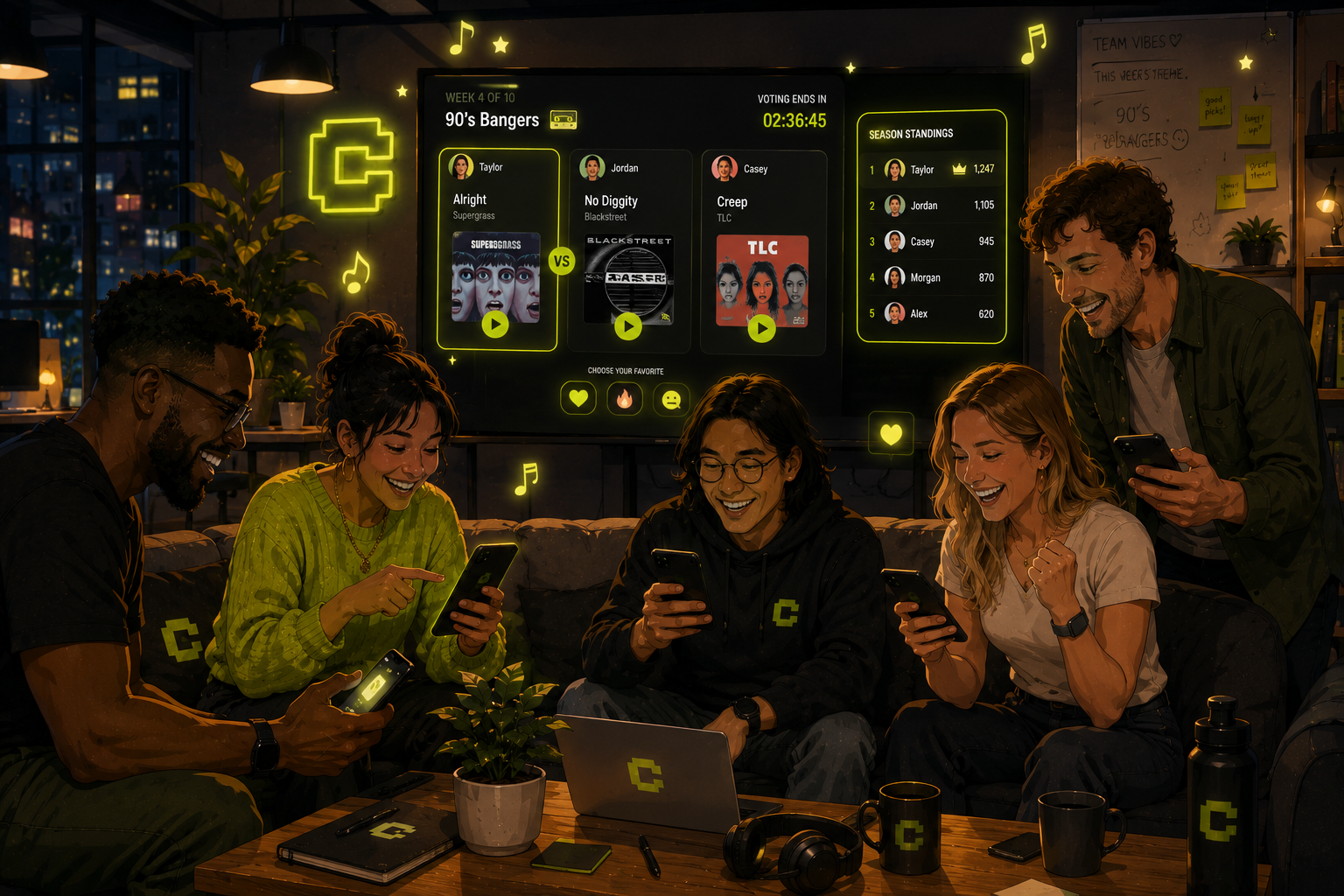
You can run the basic idea yourself in a group chat or shared playlist. If you want the competition, voting, and standings handled for you, Cut Club is built around this format.
In Cut Club, each round has a theme. Players submit one song, listen to the other picks, and vote. Points stack across the season until a champion is crowned.
The music gives people something to talk about, while the standings give the activity a reason to keep going.
2. Start a Photo Prompt Thread
Best for: Low-effort participation
Post one photo prompt at the beginning of the week and give everyone a few days to respond.
Try prompts like:
- Your current desk view
- The best thing you ate this week
- Something within five feet of you that has a story
- Your pet interrupting work
- The oldest thing on your desk
People can respond whenever they have time, and the photos naturally create conversation without requiring a formal activity.
Keep the prompts easy. The goal is not to get the perfect photo. It is to give coworkers a small glimpse into each other's lives.
3. Create a Rotating Recommendation Club
Best for: Sharing interests beyond work
Pick a category each week and let everyone drop one recommendation.
It could be:
- A movie
- A restaurant
- A podcast
- A game
- A book
- A recipe
- A YouTube channel
You can also rotate who chooses the category.
This works because participation takes a minute, but the recommendations can spark conversations for days.
It also gives people an easy way to share their interests without an icebreaker asking them to explain their entire personality to the team.
4. Make a Prediction Board
Best for: Teams that enjoy friendly competition
Choose something with an outcome that will be known later and let everyone make a prediction.
That might be an awards show, a sports event, a product announcement, or something happening inside your own company.
Keep a simple scoreboard for correct predictions.
The activity becomes more interesting when predictions have receipts. Once everyone has committed to an answer, the eventual result gives the team something to revisit.
Just keep the subjects accessible enough that people do not need expert knowledge to participate.
5. Play Two Truths and a Lie Over Several Days
Best for: Learning unexpected things about coworkers
Two truths and a lie does not need to happen live.
Have one person post three statements about themselves. Everyone else has until the next day to guess which one is false.
Then the person reveals the answer and gives the story behind one or two of the statements.
The slower format can actually make the game better. People have time to debate their guesses, ask suspicious follow-up questions, and commit to an answer before the reveal.
Rotate to a new person each week instead of trying to get the entire team through the game at once.
6. Build a Team Map
Best for: Distributed teams
If your team is spread across cities, states, or countries, create a shared map showing where everyone is based.
Then ask each person to add one local recommendation.
It could be their favorite coffee shop, a park, a restaurant, a strange landmark, or something visitors should actually do if they are ever in town.
The map becomes more than a list of locations. It gives the team context about where everyone is working from and creates easy conversation around local differences.
It can also become useful when coworkers eventually travel or meet in person.
7. Run a Tiny Creative Challenge
Best for: Breaking up routine
Give everyone the same small creative constraint.
For example:
- Write the worst possible slogan for your company
- Rename your team like it is a band
- Design a terrible new product feature
- Explain your job using only five words
- Turn a current project into a movie title
Give people a day or two to respond, then let the team react to the entries.
The constraint matters. "Be creative" feels like work. A weird, specific prompt gives people somewhere to start.
8. Create a Team Bracket
Best for: Debate-heavy teams
Pick 8 or 16 things and put them into a bracket.
Coffee versus tea. Dogs versus cats. Breakfast foods. Movie franchises. Office snacks. Fast food fries.
Open one matchup at a time and let people vote asynchronously.
The subject does not need to matter. In fact, it is often better when it does not.
The fun comes from people defending completely unnecessary opinions with surprising intensity.
9. Run a Guess Who Challenge
Best for: Teams that already know each other a little
Collect one answer from each person to a prompt, then post the answers anonymously.
Prompts might include:
- First concert
- Childhood dream job
- Most-used emoji
- Strangest food combination you actually like
- A hobby nobody at work knows about
Everyone guesses which answer belongs to which coworker.
Reveal the answers later and let people explain the stories behind them.
This works especially well when the prompts are specific enough to produce interesting answers but not so personal that participating feels uncomfortable.
10. Start a Wins and Recommendations Thread
Best for: A simple recurring ritual
At the end of the week, create one thread with two prompts:
- What is one win from your week?
- What is one thing you would recommend?
The win can be work-related or personal. The recommendation can be anything.
This gives the team a lightweight way to recognize progress while also sharing something beyond work.
Because the format stays the same each week, nobody needs instructions after the first few times.
What Makes Async Team Building Actually Work?
The best async team activities have a few things in common.
Keep the ask small
People should understand what to do immediately.
Submit one song. Post one photo. Make one prediction. Vote on one matchup.
If participating requires a long explanation or 30 minutes of preparation, it starts feeling like another assignment.
Create a window, not a moment
Give people enough time to participate around their actual schedules.
A remote activity stops being truly async if everyone has to respond within the same 20 minutes.
Make participation feel optional
Not every activity will appeal to every person.
That is fine.
Async team building works best when people can jump into the activities they enjoy instead of feeling like participation is being tracked.
Give people something to react to
The best activities do not end when someone submits an answer.
They create a second layer: voting, guessing, debating, reacting, or seeing a result.
That interaction is what turns a prompt into something social.
Repeat the formats people like
You do not need a completely new team building idea every week.
If your team gets invested in a bracket, run another bracket later. If a weekly music competition starts generating trash talk, keep the season going.
A recurring activity can become part of the team's culture in a way a one-time virtual event rarely does.
Try a Recurring Activity Instead of Another Event
Remote team building does not have to mean getting everyone onto the same call.
Give people a small reason to interact outside their normal work conversations. Keep the commitment low. Leave enough time for different schedules and time zones. Then see which activities your team actually wants to repeat.
If your team already shares music, argues about artists, or fights over who has the best playlists, Cut Club gives that energy somewhere to go.
Start a club, invite your coworkers, and play your first trial season free. The trial runs for two matchups, with one themed song submission per player each round.
No virtual happy hour required.
Cut Club
Play with your people.
Weekly themes, one song per matchup, votes, banter, recaps. Bring your group.
Related posts
Aug 3, 2026 · CutClub Team
15 Team Building Music Games Your Team Will Actually Enjoy in 2026
Looking for team building music games your team will actually enjoy? Discover 15 fun activities for remote teams, office events, and company socials that bring people together through music.
#team-building #workplace #remote-teams

Sep 28, 2026 · CutClub Team
How to Run a Music League at Work Without Making It Feel Like Forced Fun
Want to start a music league at work without another awkward team-building exercise? Here’s how to keep it low-pressure, competitive, and actually fun.
#team-building #workplace-games #music-games

Sep 21, 2026 · CutClub Team
20 Music Competition Themes That Lead to Great Song Picks
Need a theme for your next music competition? Try these 20 song challenge prompts built for better picks, new discoveries, and plenty of debate.
#music-themes #music-games #music-competition